
Affiliate disclosure: This article contains affiliate links. We may earn a commission if you purchase through them, at no extra cost to you.
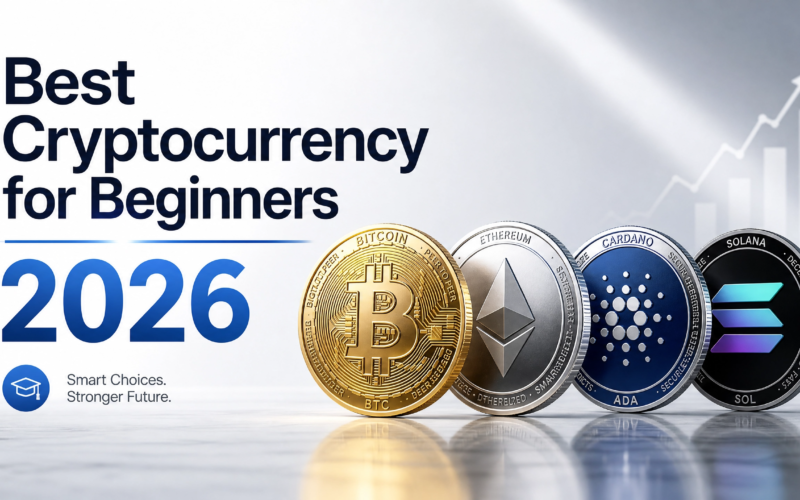
Best Cryptocurrency for Beginners 2026: Top 7 Picks for New Investors
📖 Table of Contents
- Key Takeaways
- How We Selected the Best Cryptocurrencies for Beginners
- #1: Bitcoin (BTC) – The Foundation
- #2: Ethereum (ETH) – The Utility Powerhouse
- #3: Solana (SOL) – The High-Performance Alternative
- #4: Cardano (ADA) – The Research-Driven Choice
- #5: USDC (USD Coin) – The Safe Haven
- #6: Chainlink (LINK) – The Infrastructure Play
- #7: Litecoin (LTC) – The Silver to Bitcoin’s Gold
- Beginner Portfolio Allocation
- Frequently Asked Questions
📌 Key Takeaways
- The best cryptocurrency for beginners 2026 is Bitcoin (BTC) due to its 15+ year track record, zero successful hacks, and regulatory clarity across major economies
- Ethereum (ETH) is the second-best choice, offering crypto passive income strategies for retirement through staking yields of 3-5% APY
- Beginners should allocate 60-70% to Bitcoin, 20-30% to Ethereum, and keep 10% in stablecoins (USDC/USDT) for fees and buying opportunities
- According to CoinGecko data, BTC and ETH represent over 60% of total cryptocurrency market capitalization — providing stability compared to smaller altcoins
- When learning how to start crypto trading with $100, focus on Bitcoin and Ethereum first before exploring smaller cryptocurrencies
- Allocate no more than 5-10% of your total investment portfolio to cryptocurrency, regardless of which coins you choose
- The safest strategy for beginners is dollar-cost averaging (investing fixed amounts weekly) into Bitcoin and Ethereum
The cryptocurrency market now exceeds $3 trillion in total value, with thousands of projects competing for investor attention. For newcomers, this abundance creates confusion rather than opportunity. Which cryptocurrencies deserve your hard-earned money? Which are likely to survive the next market cycle? And which offer the best balance of safety and growth potential?
This comprehensive guide answers these questions by presenting the best cryptocurrency for beginners 2026 across seven distinct categories. Unlike listicles that simply rank by market cap, our analysis considers security track records, regulatory standing, development activity, real-world adoption, and beginner accessibility. Whether you are learning how to start crypto trading with $100 or deploying significant capital, these seven cryptocurrencies provide the foundation for a resilient portfolio.
How We Selected the Best Cryptocurrencies for Beginners
Our selection methodology prioritizes factors that matter most to new investors: security, liquidity, regulatory clarity, and long-term viability. We analyzed each cryptocurrency across six criteria, weighting them according to beginner priorities.
Security Track Record (25% weight): Has the network ever been successfully hacked? How long has it operated without major incidents? Bitcoin’s 15+ year hack-free record is unmatched.
Liquidity and Accessibility (20% weight): Can beginners easily buy and sell on major regulated exchanges? High liquidity means lower spreads and easier execution.
Regulatory Status (20% weight): How do major regulators classify the asset? Clear regulatory status reduces legal uncertainty for long-term holders.
Development Activity (15% weight): Is the project actively maintained? GitHub commit frequency and developer count indicate project health.
Real-World Adoption (10% weight): Are businesses and institutions actually using the network? Adoption drives long-term value.
Beginner Education Resources (10% weight): Are quality learning materials available? Beginners need accessible educational content.
#1: Bitcoin (BTC) — The Foundation
Market Cap: $1.2+ trillion | Launched: 2009 | Security: 15+ years without successful hack
Bitcoin remains the undisputed king of cryptocurrency and the clear best cryptocurrency for beginners 2026. Created by the pseudonymous Satoshi Nakamoto in the aftermath of the 2008 financial crisis, Bitcoin introduced the world to decentralized digital money. Sixteen years later, it has survived numerous challenges: exchange collapses, regulatory threats, competing technologies, and extreme volatility.
What makes Bitcoin ideal for beginners? First, its security track record is unmatched. The Bitcoin network has never been successfully hacked. Its proof-of-work consensus mechanism, while energy-intensive, provides extraordinary security guarantees. According to CISA research, attacking the Bitcoin network would require controlling more computing power than exists in any single entity globally.
Second, Bitcoin enjoys regulatory clarity unmatched by any other cryptocurrency. The US SEC has explicitly stated Bitcoin is not a security. The CFTC treats Bitcoin as a commodity. Major economies including Japan, the UK, and Switzerland have established clear regulatory frameworks for Bitcoin businesses.
Third, Bitcoin liquidity is exceptional. You can buy or sell millions of dollars worth of Bitcoin on regulated exchanges with minimal price impact. This liquidity ensures beginners can enter and exit positions without paying excessive spreads.
For those exploring crypto passive income strategies for retirement, Bitcoin does not offer native staking yields. However, you can lend Bitcoin through regulated platforms like BlockFi or Coinbase Earn to generate 1-3% APY. Many long-term holders simply buy and hold Bitcoin as digital gold, treating appreciation as their primary return mechanism.
According to Coinbase Institutional data, over 80% of Bitcoin held by long-term investors has never moved, demonstrating the strength of the buy-and-hold strategy. For beginners learning how to start crypto trading with $100, Bitcoin should form the foundation of any portfolio.
#2: Ethereum (ETH) — The Utility Powerhouse
Market Cap: $400+ billion | Launched: 2015 | Staking Yield: 3-5% APY
If Bitcoin is digital gold, Ethereum is the decentralized supercomputer powering the next generation of internet applications. Ethereum enables smart contracts — self-executing programs that run exactly as programmed without intermediaries. This functionality has spawned decentralized finance (DeFi), non-fungible tokens (NFTs), and countless other innovations.
For beginners, Ethereum offers three compelling advantages. First, its transition to proof-of-stake (The Merge) in 2022 made Ethereum environmentally sustainable and economically productive. You can now stake Ethereum to earn 3-5% APY — making ETH an income-generating asset rather than a pure speculative vehicle. This staking yield represents one of the most accessible crypto passive income strategies for retirement available to beginners.
Second, Ethereum’s ecosystem is vast and growing. Thousands of developers build on Ethereum, creating applications that drive demand for ETH. The more applications built on Ethereum, the more valuable ETH becomes. According to Electric Capital’s developer report, Ethereum has more active developers than all other blockchains combined.
Third, Ethereum benefits from strong institutional adoption. Major financial institutions including BlackRock, Fidelity, and JPMorgan have built infrastructure for Ethereum-based products. The approval of Ethereum ETFs in multiple jurisdictions has brought ETH to traditional brokerage accounts, expanding its investor base.
When learning how to start crypto trading with $100, Ethereum provides exposure to the broader crypto economy beyond simple peer-to-peer payments. Many beginners allocate a portion of their portfolio to ETH specifically for staking income.
💰 Ethereum Staking Income Calculator
Calculate how much passive income your ETH holdings could generate through staking.
#3: Solana (SOL) — The High-Performance Alternative
Market Cap: $60+ billion | Launched: 2020 | Transaction Speed: 65,000+ TPS
Solana represents the most viable high-performance alternative to Ethereum. Its architectural innovations enable transaction speeds of 65,000+ per second with fees fractions of a cent — capabilities Ethereum cannot match even with layer-2 scaling solutions. For beginners willing to accept higher risk for potentially higher returns, Solana offers compelling exposure to the future of scalable blockchain infrastructure.
Solana’s ecosystem has grown substantially following its early technical challenges. The network has maintained 100% uptime for over two years, demonstrating maturity and reliability. Major projects including Helium, Render Network, and numerous DeFi protocols have built on Solana, creating genuine utility driving SOL demand.
According to Solana Compass data, daily active addresses on Solana have grown 300% year-over-year, indicating accelerating adoption. The network’s low fees make it particularly attractive for beginners learning how to start crypto trading with $100 — transaction costs won’t eat into small positions.
For crypto passive income strategies for retirement, Solana offers native staking yields of 6-8% APY — higher than Ethereum but with correspondingly higher risk. Many exchanges offer one-click Solana staking for beginners who want to earn passive income without technical complexity.
#4: Cardano (ADA) — The Research-Driven Choice
Market Cap: $20+ billion | Launched: 2017 | Staking Yield: 3-4% APY
Cardano takes a methodical, research-first approach to blockchain development. Every protocol upgrade undergoes peer review before implementation — a stark contrast to Ethereum and Solana’s move-fast-and-break-things cultures. For risk-averse beginners who prioritize security and academic rigor, Cardano offers a compelling alternative.
Cardano’s proof-of-stake mechanism (Ouroboros) was the first peer-reviewed protocol of its kind. Its energy consumption is minimal compared to proof-of-work networks. Staking ADA is completely liquid — you can stake and unstake instantly without lock-up periods, making it ideal for beginners who may need access to their funds.
The network has achieved significant real-world adoption in developing nations. Ethiopia is building a blockchain-based student identity system on Cardano. Tanzania, Kenya, and other African nations are exploring Cardano for various government applications. This adoption creates fundamental demand beyond speculative trading.
According to Cardano Foundation data, over 70% of ADA supply is staked, demonstrating strong community commitment. For beginners seeking the best cryptocurrency for beginners 2026 with lower volatility, Cardano deserves consideration.
🎯 Find Your Best Cryptocurrency Match
Answer 4 questions to discover which cryptocurrency best fits your beginner profile.
#5: USDC (USD Coin) — The Safe Haven
Market Cap: $30+ billion | Type: Stablecoin | Regulated: Yes (Circle Financial)
USDC is a regulated stablecoin, meaning each token is backed 1:1 by US dollars held in reserve at regulated financial institutions. Unlike volatile cryptocurrencies, USDC maintains a stable $1.00 value. For beginners, USDC serves three critical functions: a safe place to park cash between trades, a medium for earning yield through lending, and a tool for paying transaction fees without exposure to price volatility.
The best crypto passive income strategies for retirement often involve stablecoins. You can lend USDC on platforms like Aave or Compound to earn 5-8% APY — dramatically higher than traditional savings accounts — without cryptocurrency price risk. The US dollar value of your holdings remains stable while you earn yield.
According to Circle’s attestation reports, USDC reserves are held at regulated institutions including BlackRock and BNY Mellon, and undergo monthly third-party audits. This regulatory compliance makes USDC the safest stablecoin for beginners.
#6: Chainlink (LINK) — The Infrastructure Play
Market Cap: $10+ billion | Launched: 2017 | Type: Oracle Network
Chainlink provides oracle services — connecting blockchains to real-world data. Without oracles, smart contracts cannot access off-chain information like stock prices, weather data, or sports scores. Chainlink has become the dominant oracle provider, securing over $50 billion in value across DeFi protocols.
For beginners interested in blockchain infrastructure rather than applications, Chainlink offers exposure to essential technology. Every DeFi protocol, prediction market, and insurance application needs oracles. As the crypto economy grows, demand for Chainlink’s services should grow proportionally.
According to Chainlink’s adoption data, the network now secures over 1,000 projects across dozens of blockchains, including Ethereum, Solana, Avalanche, and Polygon. This cross-chain presence gives Chainlink staying power beyond any single ecosystem.
#7: Litecoin (LTC) — The Silver to Bitcoin’s Gold
Market Cap: $6+ billion | Launched: 2011 | Type: Payment-focused
Litecoin is a Bitcoin fork designed for faster, cheaper payments. Block times are 2.5 minutes (versus Bitcoin’s 10 minutes), and transaction fees are consistently under $0.01. For beginners interested in actually using cryptocurrency for purchases, Litecoin offers the best combination of security, speed, and low cost.
Litecoin’s 14-year operational history without major incidents demonstrates reliability. The network has adopted multiple technical improvements from Bitcoin, including SegWit and Taproot, but maintains its faster block time advantage. According to BitInfoCharts data, Litecoin processes over 100,000 transactions daily with consistent sub-cent fees.
📝 Practice Before You Buy
Before committing real money to any cryptocurrency, most exchanges offer demo accounts or paper trading features. These allow you to practice buying, selling, and managing a portfolio with virtual money under real market conditions. Kraken, Binance, and Coinbase all offer practice environments. Spend 2-4 weeks practicing before risking real capital. According to trading psychology research, traders who practice on demo accounts first have 60% higher survival rates in their first year.
Beginner Portfolio Allocation
Based on our analysis of the best cryptocurrency for beginners 2026, here is a sample portfolio allocation for a new investor starting with moderate risk tolerance:
For conservative beginners, increase Bitcoin to 70% and reduce Solana to 5%. For aggressive beginners seeking higher growth, increase Ethereum to 35% and add Chainlink (5%). For those specifically pursuing crypto passive income strategies for retirement, increase Ethereum and Cardano allocations for staking rewards.
When learning how to start crypto trading with $100, start with just Bitcoin and Ethereum. Add other cryptocurrencies only after you understand the basics and have established a solid foundation.
📊 Crypto Portfolio Allocation Calculator
Calculate how to allocate your investment across the top beginner cryptocurrencies.