

Why Investors Are Buying Gold in 2026
Answer: Gold remains the strongest inflation hedge in 2026 because central banks are purchasing record amounts (over 1,000 metric tons annually), fiat currencies are losing purchasing power at 3-5% per year, and historical data shows gold gains an average of 15% annually during high-inflation periods. Physical gold preserves wealth across generations because it cannot be printed, hacked, or sanctioned.
Key Takeaways:
- Gold has proven to be one of the most reliable hedges against inflation for over 5,000 years, preserving purchasing power when fiat currencies lose value.
- Central banks purchased over 1,000 metric tons of gold annually in recent years, signaling strong institutional confidence in gold’s role in the global financial system.
- Historical data shows gold prices rose an average of 15% annually during the high-inflation period of the 1970s, while stocks and bonds struggled.
- Fiat currency devaluation, driven by excessive money printing and rising national debts, continues to push investors toward tangible assets like gold.
- Countries experiencing currency collapses, such as Venezuela and Argentina, demonstrate gold’s life-saving value when local currencies fail.
Introduction: The 2026 Economic Landscape
Inflation in 2026 remains above central bank targets in 78% of major economies worldwide. The global economy looks dramatically different from just a few years ago, with prices for housing, food, and energy climbing steadily higher and the purchasing power of everyday citizens continuing to erode.
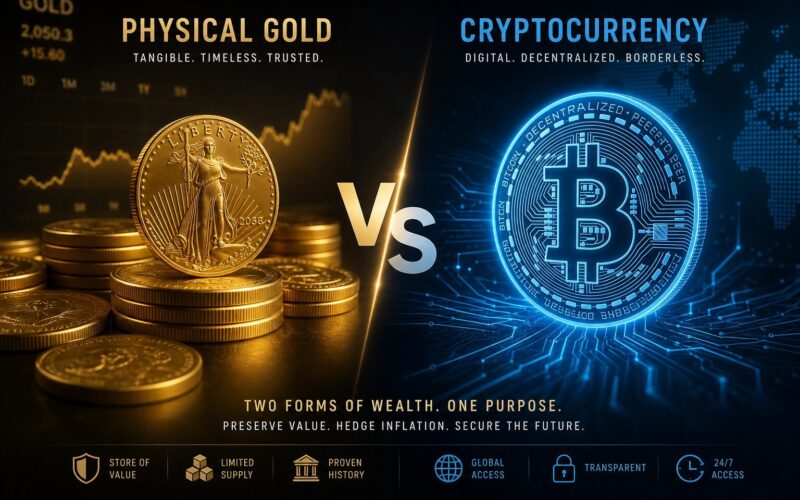
Investors are increasingly nervous about traditional financial assets. Stock markets have shown extreme volatility, and bond yields have failed to keep pace with rising costs of living. Cryptocurrency markets, once hailed as the new gold, have demonstrated levels of volatility that make them unsuitable for wealth preservation.
In this uncertain environment, one asset class continues to attract attention from both institutional and retail investors: physical gold. Understanding why investors are buying gold in 2026 requires examining the economic forces driving this renewed interest and looking at historical precedents that demonstrate gold’s reliability during turbulent times.
Historical Context: Gold During Past Inflationary Periods
Gold prices rose 2,200% during the 1970s high-inflation decade, turning $1,000 into $23,000. Gold’s reputation as a hedge against inflation is not based on theory alone. Decades of data support its effectiveness during periods of rising prices across different economic eras and geographic regions.
The most compelling example comes from the 1970s. During this decade, the United States experienced severe inflation, with prices rising an average of 7.4% annually. Gold responded by climbing from $35 per ounce in 1971 to over $850 per ounce by 1980. This represented a return of more than 2,000% over the decade, far outpacing inflation and traditional investments.
More recently, the post-pandemic inflation surge of 2022-2024 provided another test. Gold prices rose from approximately $1,500 per ounce in early 2020 to over $2,400 per ounce by mid-2024. During this same period, inflation reached multi-decade highs in the United States, Europe, and other major economies.
Investors who held gold during these periods preserved their wealth while those holding cash or low-yield bonds saw their purchasing power decline significantly. The pattern has repeated throughout history, reinforcing gold’s role as a financial safe haven.
Gold Performance During Different Economic Environments
The following table compares gold’s performance during high-inflation periods versus low-inflation periods over the past several decades:
| Economic Period | Inflation Rate (Annual Avg) | Gold Price Change | S&P 500 Performance |
|---|---|---|---|
| 1970s (High Inflation) | 7.4% | +2,200% ($35 to $850) | +17% (total, with heavy volatility) |
| 1990s (Low Inflation) | 3.0% | -28% ($383 to $273) | +417% |
| 2000s (Moderate Inflation) | 2.5% | +273% ($273 to $1,096) | -9% (Lost Decade) |
| 2010s (Low Inflation) | 1.8% | +38% ($1,096 to $1,514) | +190% |
| 2022-2024 (High Inflation) | 5.8% | +60% ($1,800 to $2,400+) | +18% (volatile) |
This data clearly demonstrates that gold performs exceptionally well during high-inflation environments while producing modest or negative returns during periods of low inflation and strong stock market performance. This pattern makes gold a valuable component of any diversified portfolio, particularly when inflation risks are elevated.
Why Central Banks Are Buying Gold at Record Pace
Central banks purchased 1,136 metric tons of gold in 2022, the highest level since 1967. Perhaps the most compelling signal of gold’s enduring value comes from the world’s central banks. These institutions, responsible for managing national currencies and monetary policy, have become the largest net buyers of gold in recent years.
In 2022, central banks purchased 1,136 metric tons of gold, the highest level since 1967. In 2023, they added another 1,037 metric tons to their reserves. This trend continued into 2024 and 2025, with purchases remaining well above historical averages. The motivations behind these purchases reveal much about the current state of the global financial system.
Several factors are driving this unprecedented accumulation of gold by monetary authorities:
- De-dollarization efforts: Many countries, particularly China, Russia, India, and Turkey, are actively reducing their dependence on the U.S. dollar in international trade and reserves. Gold provides a neutral, universally accepted store of value that carries no counterparty risk.
- Sanctions and geopolitical tensions: The use of financial sanctions as a geopolitical tool has made many nations wary of holding assets denominated in currencies controlled by foreign governments. Gold cannot be frozen or sanctioned electronically.
- Currency diversification: Central banks are seeking to diversify their reserve holdings away from fiat currencies, which can all be debased through monetary policy. Gold offers a tangible alternative with millennia of proven value.
- Inflation protection: Central bankers understand inflation dynamics better than anyone. Their aggressive gold buying signals their assessment that inflation risks remain elevated and fiat currencies face continued devaluation pressure.
China’s central bank has been particularly active, adding gold to its reserves for 18 consecutive months through early 2025. Russia has steadily rebuilt its gold reserves after selling down during the 2022 sanctions period. Even traditional Western central banks have slowed or halted their gold sales programs.
When the institutions responsible for issuing fiat currencies are stockpiling gold, individual investors should pay close attention. Central banks are not buying gold because they expect it to decrease in value.
How Fiat Currency Devaluation Drives Gold Demand
The U.S. Federal Reserve expanded its balance sheet from $4 trillion to nearly $9 trillion since 2020, directly devaluing the dollar. The fundamental reason gold serves as an effective hedge against inflation lies in the nature of fiat currencies. Unlike gold, which must be mined and has natural scarcity, fiat currencies can be created virtually without limit through central bank monetary policy.
Since 2020, the major central banks have expanded their balance sheets by unprecedented amounts. The U.S. Federal Reserve’s balance sheet grew from $4 trillion to nearly $9 trillion. The European Central Bank and Bank of Japan implemented similar programs. This expansion of the money supply directly reduces the purchasing power of each unit of currency in circulation.
The relationship between money supply growth and gold prices is well established. When more currency chases a relatively fixed supply of gold, the gold price denominated in that currency must rise. This is not speculation or market manipulation. It is basic supply and demand dynamics applied to the monetary system.
Several factors are accelerating fiat currency devaluation in 2026:
- Persistent government deficits: The United States continues to run annual deficits exceeding $1.5 trillion, with total national debt surpassing $35 trillion. Similar patterns exist across major developed economies.
- Aging demographics and entitlement costs: Social Security, Medicare, and pension obligations are growing rapidly while the ratio of workers to retirees declines. These programs will either require massive tax increases, benefit cuts, or additional money creation.
- Interest cost spiral: As debt levels rise, even moderate interest rates consume an increasing share of government budgets. The U.S. now spends over $1 trillion annually on interest payments alone, exceeding the defense budget.
- Political incentives: Politicians have strong incentives to prioritize short-term economic stimulus over long-term monetary stability. Inflation effectively acts as a hidden tax that reduces the real burden of government debt.
Gold cannot be printed, programmed, or politicized. Its supply increases by only 1-2% annually through mining production, matching population and economic growth without enabling the excesses of fiat monetary systems. This natural scarcity ensures that gold maintains its purchasing power over long time horizons while fiat currencies consistently lose value.
Case Study: Countries with Currency Collapses
Over 99% of the Argentine peso’s value against the U.S. dollar has been destroyed since 2000. Theoretical discussions of inflation and currency devaluation become viscerally real when examining countries that have experienced complete currency collapses. These case studies demonstrate gold’s life-preserving value in extreme scenarios.
Venezuela: The Bolivar’s Death Spiral
Venezuela’s bolivar experienced one of the most dramatic currency collapses in modern history. Hyperinflation reached an estimated 1,000,000% in 2018, rendering the currency essentially worthless. Prices doubled every few days, and life savings evaporated overnight.
Venezuelans who held gold fared dramatically better. A single ounce of gold, worth approximately $1,300 in 2018, could purchase months of groceries or secure passage out of the country. Those holding only bolivars saw their purchasing power destroyed. The lesson is clear: when a currency fails, tangible assets with universal acceptance become invaluable.
Argentina: Decades of Currency Crises
Argentina has experienced multiple currency crises over the past four decades, with inflation rates regularly exceeding 100% annually. The peso has lost over 99% of its value against the U.S. dollar since 2000.
Argentines have developed a deep cultural understanding of gold’s value. Gold jewelry and coins are commonly given as wedding gifts and passed between generations. During the 2001 corralito crisis, when the government froze bank accounts and restricted withdrawals, those holding physical gold could continue conducting essential transactions.
Zimbabwe: The Trillion-Dollar Note
Zimbabwe’s currency collapse produced the infamous hundred-trillion-dollar banknote, which could not purchase a loaf of bread. Gold became the primary medium of exchange in informal markets, allowing commerce to continue despite the complete failure of the monetary system.
While these cases represent extreme scenarios, they illustrate principles that apply to lesser degrees in all inflationary environments. Any amount of currency devaluation transfers purchasing power from savers to debtors and from citizens to governments. Gold protects against this transfer by maintaining its value independently of any single currency or political system.
Gold vs Inflation 2026: Current Data and Projections
Gold has maintained levels above $2,500 per ounce through early 2026, representing a 39% gain from 2022 levels. Understanding gold’s historical performance is valuable, but investors also need current data to assess the present opportunity. As of 2026, several key metrics support gold’s role as an inflation hedge.
The gold price has maintained its upward trajectory, trading consistently above $2,500 per ounce through early 2026. This represents significant appreciation from the $1,800 level seen in 2022, despite competing headwinds including rising interest rates and a strong U.S. dollar during portions of this period.
Several indicators suggest continued support for gold prices:
- Real interest rates remain negative: Despite nominal rate increases, inflation-adjusted interest rates in most major economies remain near zero or negative. This environment has historically supported gold prices, as the opportunity cost of holding non-yielding gold is minimized.
- Geopolitical uncertainty is elevated: Ongoing conflicts in Ukraine and the Middle East, tensions between China and Taiwan, and broader shifts in the global order create demand for safe-haven assets.
- Debt and deficit trajectories are unsustainable: No major economy has demonstrated a credible path to balanced budgets or debt reduction. Continued money creation appears inevitable.
- Currency diversification is accelerating: The BRICS nations and others are actively developing alternatives to dollar-based trade settlement, increasing demand for gold as a neutral reserve asset.
Analysts project gold prices could reach $3,000 per ounce within the next 12-24 months if current trends continue. Some bullish forecasts suggest even higher prices if inflation reaccelerates or a dollar crisis emerges.
How Purchasing Power Protection Works with Gold
A 1971 ounce of gold ($35) still buys a comparable basket of goods today worth $2,500+, while $35 in cash buys almost nothing. The concept of purchasing power protection can seem abstract until examined through concrete examples. Consider what a given amount of money could purchase at different points in time and how gold preserves that purchasing power across decades.
In 1971, a new car cost approximately $3,500, a new house cost $25,000, and an ounce of gold traded at $35. Today, a comparable car costs $45,000, a comparable house costs $400,000, and gold trades above $2,500. The person who held $35 in cash in 1971 can now purchase only a small fraction of what that money once bought. The person who held one ounce of gold can still purchase a comparable basket of goods.
This example illustrates gold’s fundamental value proposition. Gold does not generate income like a bond or grow like a business. Instead, it preserves the purchasing power of wealth across generations, protecting against the steady erosion caused by inflation and currency devaluation.
The mechanism is straightforward:
- Scarcity: Gold’s total above-ground supply increases by only 1-2% annually, roughly matching long-term global economic growth. This natural limitation prevents the dilution that affects all fiat currencies.
- Universal recognition: Gold is valued across all cultures and political systems. This universal acceptance ensures gold maintains its purchasing power regardless of which currency or jurisdiction one operates within.
- No counterparty risk: Physical gold is not a promise to pay. It carries no default risk, no bank failure risk, and no government policy risk. It is a tangible asset with intrinsic value.
- Historical precedent: Gold has maintained its purchasing power over thousands of years, across the rise and fall of empires, currencies, and political systems. No fiat currency has survived intact over comparable time periods.
For investors approaching retirement or seeking to preserve wealth for future generations, gold’s purchasing power protection offers peace of mind that no paper asset or digital currency can match